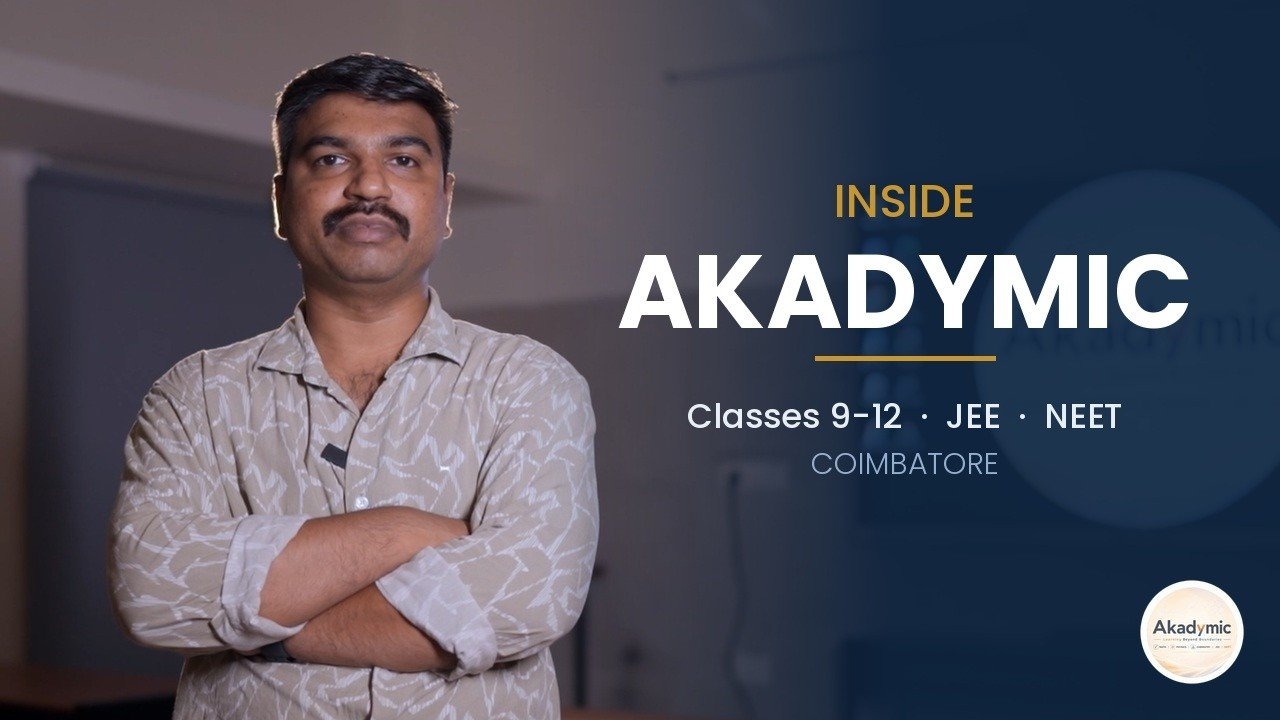
Coimbatore · Classes 9–12 · CBSE ICSE IGCSE IB · JEE & NEET
Students who can see the problem
rarely fear the paper.
Akadymic runs small, board-specific evening batches in Coimbatore. Every class ends with practice, every practice is corrected the same day, and the teacher walks into the next class already knowing who is stuck and where.
One batch per class, per board, per subject.
No mixed-year rooms. A Class 9 CBSE Science student sits with Class 9 CBSE Science students, and the pace is set for exactly that group.
Science & Maths
Foundation year — where board habits are actually built.
60–90 min sessions · evenings
Class 10 · BoardsScience & Maths
Board year. Full syllabus coverage plus weekly testing.
60–90 min sessions · evenings
Classes 9–10 · FoundationScience & Maths
For students aiming at entrance exams from Class 9 onward.
60–90 min sessions · evenings
Class 11 · BoardsPhysics · Chemistry · Maths
The year most students lose ground. We slow down where it matters.
60–90 min sessions · evenings
Class 12 · BoardsPhysics · Chemistry · Maths
Boards, with revision and previous-year work built into the year.
60–90 min sessions · evenings
Classes 11–12 · EntranceJEE & NEET
The LearnWithAnish vertical, taught alongside boards — not instead of them.
60–90 min sessions · evenings
ICSE, IGCSE and IB students are taught in one-to-one and small-group formats, online or at the centre.
Concept first. Formula last. Always.
Three things happen in every Akadymic class. A parent should be able to repeat them at the dinner table.
Concept before formula
Students learn to picture what is physically happening in a problem — the direction, the change, the limit case — before an equation is written. Formulas then feel obvious instead of arbitrary.
Exam-trap exposure
Every question in a board or entrance paper is designed. We show students how the trap was built and which wrong answer it was built to attract, so the exam hall holds no surprises.
Socratic questioning
Faculty ask rather than tell. The student reaches the answer, and that is precisely why it stays — long past the test.
The difference is operational, not promotional.
Every claim below is a working arrangement at the centre, not a slogan.
Practice corrected before the class ends
A dedicated academic team prepares and corrects DPPs, worksheets and weekend tests. Corrected work reaches the teacher the same evening.
3-student and 12-student batches
Batch sizes are capped, and one-to-one is available online or at the centre. Nobody sits at the back.
Faculty teach. They don't do admin.
Portion tracking, attendance, material preparation and correction sit with a separate team, so teaching time stays teaching time.
Our own study material
Worksheets, formula collections, wall posters and practice sets are produced here — not photocopied from the market.
- Weekend tests every week, run by a separate testing team.
- A dedicated online portal — web and app — for tests, assignment submission and doubts, with separate parent and student dashboards.
- No PPTs. Faculty teach live at the board, in front of the class.
- Contemporary examples — where the concept being taught is actually used today.
- Alumni and senior-student interactions through the year.
- Counselling for students and parents — screen time, exam pressure, and career disagreements at home.
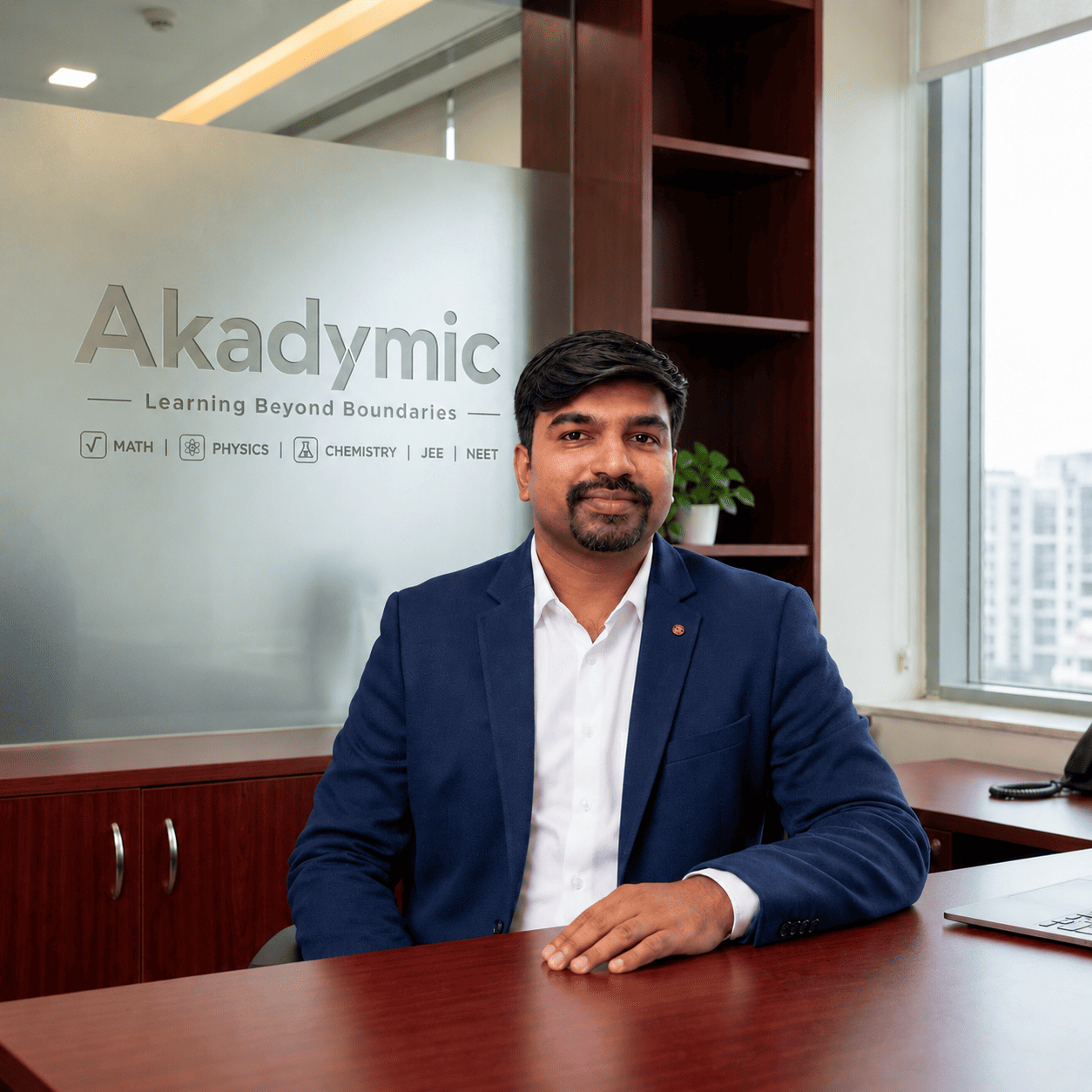
Anish Kumar. S
Founder · Physics, Chemistry & Mathematics
Fifteen years of teaching Physics, Chemistry and Mathematics — Classes 9 to 12, JEE, NEET, and up to BTech and MTech level, including GATE (Mechanical) coaching. He holds an ME.
Akadymic began in 2026 as the structured, batch-class institute built on top of that practice. He still teaches, and still writes the material his students use.
Meet the facultyWhere our students went.
Alumni have gone on to:
Engineering Colleges
Medical Colleges
LearnWithAnish — the entrance vertical
Boards and entrance, without sacrificing either.
LearnWithAnish predates Akadymic by more than a decade. Classes 11 and 12 students prepare for JEE or NEET in Physics, Chemistry and Mathematics on a chapter map that runs alongside the board syllabus rather than competing with it.
GV Residency, Masakalipalayam Road.
Smart-board classrooms, a reference library, a one-to-one room, and a waiting area for parents. Come and sit in on a class before you decide anything.
| Address | GV Residency, Masakalipalayam Road, Coimbatore, Tamil Nadu |
|---|---|
| Batch timings | Every evening, 5:30 PM – 9:30 PM |
| Phone / WhatsApp | +91 80563 31631 |
| hello@akadymic.com |
Book a free demo class.
Tell us your child's class and board. We'll suggest a batch, a demo slot, and a time to talk. No fees are quoted online — we'd rather explain them in person.
"Sir's classes made physics feel logical instead of something to memorise. I stopped being scared of the paper."
Aishwarya · Now studying in Kumaraguru College of Technology, Coimbatore
Our approach
Memorisation stopped working when the papers stopped being predictable.
Board and entrance papers now test whether a student understood the idea, not whether they revised the chapter. A student who has memorised forty formulas will still lose marks to a question phrased in an unfamiliar way. A student who can picture what is happening will not.
Concept before formula
A student who is handed R = u²sin2θ/g on day one has learnt a string of symbols. A student who first watches the path bend, sees the horizontal speed never change, and works out why the ball spends equal time going up and coming down, has learnt the physics. The formula then arrives as a summary of something they already believe.
So every chapter starts away from the equation. We draw it, animate it on the smart board, argue about the limit cases — what happens if the angle is zero, what happens if gravity doubles — and only then write the algebra. The same habit carries into Chemistry, where we teach shape and behaviour using molecular models and simulations before naming the rule, and into Maths, where a graph is drawn before a method is applied.
The test of whether it worked is simple: the student can rebuild the formula if they forget it.
Exam-trap exposure
Examiners do not write wrong options at random. Each one is engineered to catch a specific misunderstanding. Once a student has seen how that engineering works, they start reading questions the way the examiner wrote them.
Here is a real one. Try it the way a Class 11 student would — quickly.
A ball is thrown straight up. At the highest point of its path, what is its acceleration?
The answer is B. At the top, the velocity is zero for an instant — but gravity never switched off. Acceleration stays 9.8 m/s² downward the whole way up, at the top, and the whole way down. That is exactly why the ball doesn't hang there.
How the trap was built: option A quietly swaps velocity for acceleration and rewards the student who is pattern-matching on the phrase "comes to rest". A student who has drawn the velocity–time graph for this motion cannot fall for it. That is the whole point of the pillar — and it is why our worksheets deliberately include the tempting wrong answer instead of avoiding it.
Socratic questioning
Telling a student the answer produces a note in a book. Asking the right four questions produces a student who can get there again next month, alone, under time pressure.
Faculty are trained to hold the answer back and narrow the gap with questions instead. It is slower in the moment and considerably faster over a term — and it is the reason our classes are kept small enough for every student to actually be asked something.
Student: I don't know why the current drops.
Teacher: What did we add to the circuit?
Student: Another bulb, in series.
Teacher: So what happened to the total resistance?
Student: It went up… oh. And the voltage stayed the same.
Teacher: So?
Student: So the current has to fall. Got it.
What happens between one class and the next.
This loop runs every week of the year, for every batch. It is the part most parents never see, and the part that actually moves marks.
Class
Concept taught live at the board. No slides.
DPP issued
Daily practice problems, written in-house for that exact lesson.
Corrected same day
The academic team corrects every sheet — not the teacher.
Faculty briefed
Corrected work reaches the teacher before the next class begins.
Gaps addressed
The next class opens on what the batch actually got wrong.
Weekend test
Run by a separate testing team, with error analysis after.
Everything a student is given, we wrote.
Lecture notes, daily practice problems, worksheets, formula collections and wall posters — produced by the institute, matched to our teaching sequence, and revised every year.
Programmes · Classes 9–12
Six batches. Not one of them is a mixed room.
Most institutes fill a room and teach the average. We run a separate batch for every class and every category, because a Class 9 CBSE student and a Class 10 Foundation student do not need the same forty minutes.
| Batch | Subjects | Format |
|---|---|---|
| Class 9 Boards | Science · Maths | Batch or 1-to-1 |
| Class 10 Boards | Science · Maths | Batch or 1-to-1 |
| Classes 9–10 Foundation (entrance) | Science · Maths | Batch or 1-to-1 |
| Class 11 Boards | Physics · Chemistry · Maths | Batch or 1-to-1 |
| Class 12 Boards | Physics · Chemistry · Maths | Batch or 1-to-1 |
| Classes 11–12 Entrance (JEE/NEET) | Physics · Chemistry · Maths | Batch or 1-to-1 |
5:30 – 9:30 PM
Regular offline batches run every evening. Sessions are 60 or 90 minutes.
3 or 12 students
Two capped formats, plus one-to-one arranged case by case.
Offline & online
At the centre in Coimbatore, or live online for students elsewhere.
Open a batch to see exactly what a student gets.
We don't publish fee amounts.
Fees depend on the batch, subject count and format, and we would rather walk you through them properly than post a number that misleads you.
LearnWithAnish · Classes 11–12
JEE and NEET preparation that started long before the institute did.
LearnWithAnish has been preparing students for engineering and medical entrance exams for over fifteen years. Akadymic is the structured board-class institute that grew around it — which is why entrance students here are never treated as a side batch.
How both fit in one week.
The usual failure is a student running two disconnected syllabi — school in the morning, an unrelated entrance course at night, and no one connecting them. We sequence the entrance chapter map against the board syllabus so the same chapter is being deepened, not restarted.
Board-level problems come first and are finished properly. Entrance-level problems on the same chapter follow in the same fortnight, moving through illustrations, standard author books, our own coaching material, and finally previous-year questions.
- Physics, Chemistry and Mathematics for JEE; PCB routes for NEET.
- Chapter-level coverage plan — a full architecture already exists for JEE Physics across all 26 chapters.
- Problem sequence is fixed: illustrations → standard authors → coaching material → previous-year questions.
- Weekend test series on JEE/NEET pattern — MCQ and numerical-value questions.
- Online test portal with timed papers, explanations after submission, and topic-wise analysis charts.
Tests, doubts and progress in one place.
Our own portal — on the website and as an app — with separate logins for students and parents.
Timed papers
JEE/NEET pattern, with answers and explanations released on submission.
Assignments
Submitted through the portal, and doubts go straight to the teacher.
Progress dashboard
Attendance, test history and topic-wise performance, without having to ask.
Where marks were lost
Correct, wrong and unattempted counts, compared chapter by chapter.
Available On
Where entrance students have gone.
Engineering Colleges
Medical Colleges
Faculty
The people who will actually be in the room.
Anish Kumar. S
Founder · Physics, Chemistry & Mathematics
I have been teaching Physics, Chemistry and Mathematics for fifteen years — Classes 9 to 12, JEE and NEET, and at BTech and MTech level, including students preparing for GATE (Mechanical). I hold an ME.
For most of those years I taught one-to-one and in small groups, and I noticed the same thing every year: students rarely fail because a chapter is hard. They fail because they were handed a formula before they had any picture of what it described. Ask a student to define refractive index and many can. Ask them to predict what happens to the image when the object moves closer, and far fewer can — because nobody ever made them see it.
So the method I teach with is simple to state and slow to do properly. Draw it first. Argue about the limit cases. Ask instead of tell. Show the student how the wrong option in the question was designed, so the paper stops being a trap and starts being a conversation with the examiner.
Akadymic exists because that method needs structure around it — daily practice that actually gets corrected, batches small enough to question every student, and a team handling everything that is not teaching so that teaching stays undiluted. I still write the material, and I still take classes every evening. Outside the centre, I build the animations and interactive lessons my own students end up using on the smart board — which is my honest idea of a hobby.
Subject faculty
Chemistry
Head of Department
Classes 9–12
Mathematics
Head of Department
Classes 9–12
Computer Science
Head of Department
Classes 9–12
Chemistry
Assistant Faculty
JEE & NEET
Biology
Assistant Faculty
Classes 9–12
Physics
Assistant Faculty
Classes 9–10
Our teachers don't do admin. On purpose.
A separate academic materials team carries everything that would otherwise eat into teaching time.
Prepares and corrects
DPPs, worksheets and weekend tests are written and corrected by the academic team — corrected work reaches faculty before the class ends.
Tracks portion & attendance
Weekly portion tracking and attendance are maintained centrally, not by the person teaching.
Runs weekend tests
Weekend testing is conducted by a separate team, so faculty are not tied up on Saturdays.
Results & testimonials
Numbers, and the people behind them.
Where they are now.
Our centre · Coimbatore
GV Residency, Masakalipalayam Road.
Smart-board classrooms, a reference library, a dedicated one-to-one room, and a waiting area where parents can actually sit. Evenings, 5:30 to 9:30.
The rooms, as they are.
Smart Classroom
Reception
- Smart-board classrooms — animations and simulations used in every subject.
- Reference library — NCERT, standard authors, and entrance-exam collections.
- Molecular model kits for Chemistry, used alongside on-screen VSEPR work.
- Dedicated one-to-one room, taught on an iPad.
- Parents' waiting area and a counselling office.
- Online classes for students who can't attend in person.
1.5 KM from Fun Mall
1 KM from Perks School
Careers
If you're passionate about teaching, come and only teach.
You plan your syllabus coverage, deliver your sessions, and track how your students are improving from corrected work. Portion registers, attendance, material preparation, daily correction and weekend testing are somebody else's job here.
Chemistry · Classes 9–12
Fixed monthly compensation. Immediate joining.
2–4 days/week · evenings
Mathematics · Classes 11–12
Fixed monthly compensation. Immediate joining.
2–4 days/week · evenings
Physics · Classes 9–12
Immediate joining.
2–4 days/week · evenings
Chemistry · Classes 9–12
Immediate joining.
2–4 days/week · evenings
How to apply
Send your CV to hello@akadymic.com, or use the form. Tell us which subject and which classes you want to teach, and one thing you think most students get wrong about it.
- Present only during your own batch time — 5:30 to 8:30 PM.
- Sessions are 60 or 90 minutes; 2–4 working days a week depending on allocation.
- You will not be asked to correct DPPs or invigilate weekend tests.
Contact · Book a demo
Come and watch one class before you decide.
A demo class is free and there is no obligation afterwards. Bring your child — the decision is easier when they've sat in the room.
| Phone / WhatsApp | +91 80563 31631 |
|---|---|
| hello@akadymic.com | |
| Address | GV Residency, Masakalipalayam Road, Coimbatore, Tamil Nadu |
| Office hours | Monday to Saturday, 4:00 PM – 9:30 PM |
| We reply | Within 1 working day |